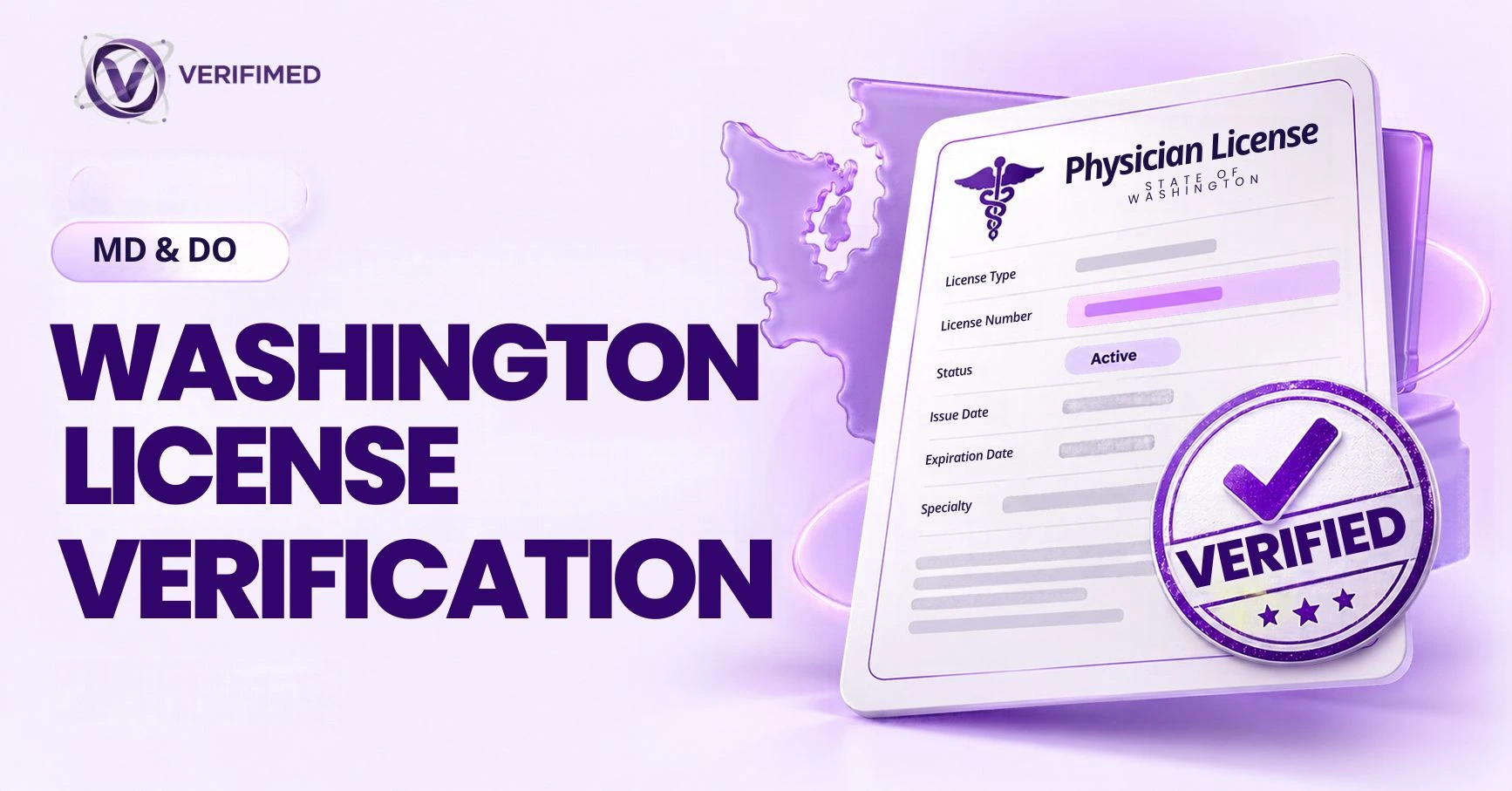
Washington Medical License Verification Requirements for Physicians
Washington medical license verification confirms whether a physician holds a valid state license and meets the applicable licensing requirements. The Washington Medical Commission regulates MD physicians, while the Board of Osteopathic Medicine and Surgery regulates DO physicians. The Washington State Department of Health provides official primary source license verification through its online credential search.
Key Takeaways
- Washington has separate licensing authorities for MD and DO physicians.
- The Department of Health provides an official online system for checking medical licenses.
- Primary source verification confirms credentials directly through the organizations that issued them.
- MD and DO physicians have different postgraduate training and license renewal requirements.
- A pending application does not authorize a physician to practice medicine.
- Hospitals should check license status and review applicable disciplinary records before granting clinical privileges.
What Does Washington Medical License Verification Mean?
Verification of a Washington medical license shows whether a physician holds a state-issued credential and whether that credential is currently valid.
The process serves two purposes: confirming an existing license and validating the qualifications submitted during a licensing application.
What Is the Difference Between License Verification and Primary Source Verification?
License verification checks the current status of a physician’s state-issued medical license. This usually includes confirming the physician’s name, credential number, license type, status, and disciplinary information.
Primary source verification means obtaining credential information directly from the institution or authority that issued or maintains the original record.
For example, a hospital can verify a Washington medical license through the Department of Health. However, verifying a physician’s residency training may require documentation directly from the training program.
Why Do Hospitals Verify Physician Licenses?
During credentialing, hospitals, clinics, and medical staff offices check physician licenses to assess a healthcare professional’s qualifications before employment, granting clinical privileges, or participation in a healthcare network. Specialty-specific processes, such as orthopedic credentialing, may require additional verification of training, experience, and clinical privileges.
A license check helps determine whether a physician has the appropriate state authorization to perform the proposed work.
However, it does not independently establish clinical competence, specialty qualifications, or eligibility for every hospital privilege.
Who Issues Physician Licenses in Washington?
In Washington, allopathic and osteopathic physicians are licensed through separate regulatory authorities within the state’s healthcare licensing framework.
Washington Medical Commission: MD Physicians
The Washington Medical Commission (WMC) regulates physicians who hold a Doctor of Medicine (MD) degree.
The commission establishes licensing standards, reviews applications, and exercises disciplinary authority under Chapter 18.71 RCW and Chapter 246-919 WAC.
Its responsibilities include reviewing medical education, licensing examinations, postgraduate training, professional history, and required disclosures.
The commission’s Physician and Surgeon Licensing Requirements page outlines the qualifications required for full MD licensure.
Board of Osteopathic Medicine and Surgery: DO Physicians
The Washington Board of Osteopathic Medicine and Surgery regulates physicians who hold a Doctor of Osteopathic Medicine (DO) degree.
The board works with the Washington State Department of Health to administer osteopathic licensing, continuing education requirements, and professional discipline.
Its licensing rules are primarily established under Chapter 18.57 RCW and Chapter 246-853 WAC.
MD and DO physicians therefore follow different licensing procedures, although both may practice medicine within their authorized scope.
How Do I Verify a Washington Physician License Online?
The official method is the Washington State Department of Health’s Provider Credential Search. The department identifies this database as a primary source for healthcare credential verification.
Step-by-Step Washington Physician License Lookup
- Visit the Washington Department of Health Provider Credential Search.
- Select the healthcare provider search option.
- Enter the physician’s name or credential number.
- Review the matching records and select the correct physician.
- Confirm the license type, current status, and expiration information.
- Check available enforcement information and disciplinary documents.
- Save or print the official verification record according to the organization’s credentialing policy.
Search results should be matched carefully to the correct physician, especially when several doctors have similar names.
What Information Does the License Verification Record Show?
The official credential system provides credential-specific information, which may include:
- Physician name and credential number
- License type and current license status
- Available issuance and expiration information
- Enforcement information and publicly available disciplinary documents
- Additional credential details displayed in the official record
Washington updated its public credential search in March 2026. The updated system provides additional information about healthcare providers, including certain credential details and enforcement case information.
Public disciplinary documents are generally available for legal disciplinary actions taken after July 1998, subject to legal disclosure restrictions.
What Do Different License Statuses Mean?
Active: The credential is currently recorded as active. Credentialing staff should still check expiration information and any applicable restrictions.
Pending: An application is under review. Pending status does not mean that a full license has been issued.
Expired: The credential has passed its expiration date without an effective renewal. An expired credential should not be treated as active authorization.
Inactive, suspended, or restricted: These designations require closer examination of the official record and any governing orders. The actual limitations depend on the individual credential.
A hospital should record the exact status displayed rather than assigning its own interpretation to an unfamiliar designation.
How Can I Check Disciplinary Actions?
The Department of Health’s credential search provides access to publicly available disciplinary and enforcement information.
When an action appears, credentialing teams should review the actual disciplinary documents rather than relying only on a summary indicator.
A record showing no public disciplinary action does not necessarily mean that a physician has never been the subject of a complaint, confidential investigation, or historical issue.
What Are the Washington Medical License Requirements for Physicians?
Washington requires physicians to demonstrate qualifying medical education, examination results, postgraduate training, and professional history before receiving full licensure.
Some eligibility requirements differ depending on whether the applicant holds an MD or DO degree.
Medical Education Requirements
MD applicants must graduate from an accredited or approved medical school recognized under Washington’s applicable licensing rules.
DO applicants must graduate from a nationally accredited, board-approved osteopathic medical school.
Education records may need to come directly from the institution or through another accepted verification source.
International medical graduates seeking MD licensure may need certification from the Educational Commission for Foreign Medical Graduates (ECFMG), along with supporting documentation.
Licensing Examination Requirements
The Washington Medical Commission recognizes the United States Medical Licensing Examination (USMLE) and certain approved historical or Canadian examination pathways for eligible MD applicants.
Applicants graduating after October 11, 1993, generally must pass the required USMLE steps or qualify through an applicable Licentiate of the Medical Council of Canada pathway described by the commission.
DO applicants must meet the board’s accepted examination requirements, which include recognized national osteopathic or other qualifying examination series.
Regulatory update: Effective October 1, 2025, Washington amended its osteopathic examination rules. The changes allow applicants to qualify through one of four nationally approved examination series and remove the Osteopathic Principles and Practices examination as a licensing examination option.
Applicants should follow current rules rather than older examination instructions that may still appear on outdated pages.
Residency and Postgraduate Training Requirements
According to Washington Medical Commission guidance, MD applicants who graduated after July 1985 generally need at least two years of qualifying postgraduate training. Those who graduated before July 1985 generally need one year.
DO applicants generally require at least one year of qualifying postgraduate training.
The training program must meet applicable accreditation requirements, and verification must be provided through an accepted institutional process.
Background Checks and Professional Disclosures
Washington reviews an applicant’s professional history and background information during licensing.
Depending on the circumstances, application requirements may include:
- Disclosure of previous and current professional licenses
- Explanation of criminal convictions or disciplinary actions
- Professional liability and malpractice history
- Relevant restrictions on hospital privileges
- Employment history and significant gaps in practice
- Criminal background checks and fingerprinting when required
The Department of Health conducts background checks on applicants and may require fingerprint-based checks through state and federal authorities. Out-of-state applicants should review the department’s applicable fingerprint requirements.
Applicants with reportable issues may undergo additional review. However, a disclosure does not automatically mean that a license will be denied.
Which Documents Require Primary Source Verification?
Primary source verification confirms that a credential was issued by the institution or authority named in an application.
Washington licensing authorities use these checks to determine whether an applicant’s qualifications are accurate.
Primary Source Verification Checklist
| Credential or Record | Primary Source | What Verification Confirms |
|---|---|---|
| Medical education | Medical school | Degree, attendance, and graduation |
| Postgraduate training | Residency or fellowship program | Training dates and completion |
| Licensing examinations | Authorized examination organization | Examination history and results |
| Previous state licenses | State medical licensing boards | License history and standing |
| ECFMG certification | Appropriate certification authority | International medical graduate certification |
| Professional privileges | Hospital or healthcare facility | Relevant appointment or privilege history |
The exact documentation required depends on the physician’s license category and application pathway.
How Does the FSMB Credentials Verification Process Work?
The Federation of State Medical Boards (FSMB) administers the Federation Credentials Verification Service (FCVS).
FCVS obtains primary source verification of medical education, qualifying postgraduate training, identity information, and licensing examinations.
It can prepare a verified credentials portfolio for submission to a licensing authority that accepts the service.
However, FCVS does not issue state medical licenses or replace the licensing authority’s final review.
The FSMB Credentials Verification Process explains which records are collected and how educational institutions and training programs provide documentation.
How Do Physicians Apply for a Medical License in Washington?
Physicians must apply through the appropriate Washington licensing process and provide the documentation needed to establish eligibility.
Step-by-Step Application Process
- Identify the appropriate licensing authority for an MD or DO degree.
- Review the current education, examination, and postgraduate training requirements.
- Select the Washington application pathway that applies.
- Complete the application and professional disclosure questions.
- Arrange the required examination scores and credential verifications.
- Submit the applicable licensing fees.
- Complete background check requirements when instructed.
- Monitor the application status and respond to requests for missing information.
- Confirm that the appropriate license has been issued before practicing.
Washington’s licensing systems provide online application options for eligible applicants.
Can Physicians Apply Through the Interstate Medical Licensure Compact?
Yes. Washington participates in the Interstate Medical Licensure Compact (IMLC).
The IMLC provides an expedited licensing process for physicians who meet its eligibility criteria.
Applicants must qualify through a State of Principal Licensure and satisfy the compact’s requirements involving medical education, postgraduate training, examinations, specialty certification, and professional history.
The compact does not establish a single license that is valid in every participating state.
Instead, each selected participating state issues its own medical license.
The IMLC Application and Eligibility Guidance explains how physicians can determine their eligibility and apply.
How Can Physicians Request Washington License Verification for Another State?
Physicians applying for licensure in another state may need official verification of their existing Washington medical license.
The receiving state determines which verification formats it will accept.
Verification for Washington MD Physicians
The Washington Medical Commission explains the available methods for sending or obtaining MD license verification through its Verification Requests guidance.
Physicians can also use the official Department of Health credential search to print a license verification record.
The commission provides an electronic verification option for transmission to other state medical boards.
Physicians should confirm whether the receiving board accepts a printed record or requires verification through a designated process.
Verification for Washington DO Physicians
Osteopathic physicians should follow the Department of Health’s credential verification instructions and any additional requirements established by the receiving jurisdiction.
Physicians who hold licenses in multiple states may need separate verifications from each issuing licensing authority.
A valid Washington medical license does not replace another state’s independent licensing requirements.
What Are Washington Physician License Renewal and CME Requirements?
Washington physicians must renew their licenses and complete the continuing education requirements applicable to their license type.
Continuing medical education (CME) refers to educational activities that help physicians maintain professional knowledge and meet licensing requirements.
MD License Renewal and CME Requirements
According to the Washington Medical Commission:
- MD licenses generally renew every two years on or before the physician’s birthday.
- Physicians must complete 200 hours of continuing education every four years.
- Applicable one-time suicide prevention and opioid prescribing training requirements must be satisfied.
- Physicians must complete required workforce demographic reporting.
Washington also has continuing education requirements related to health equity. MD physicians should review the current rules and reporting cycle when checking their CME records.
DO License Renewal and Continuing Education Requirements
According to the Washington State Department of Health:
- DO licenses renew annually and generally expire on the physician’s birthday.
- Osteopathic physicians must complete 150 hours of continuing education every three years.
- At least 60 hours must be Category 1A continuing education.
- Applicable one-time suicide prevention and opioid prescribing training requirements must be satisfied.
- Health equity continuing education and workforce survey requirements also apply.
These requirements are explained in the DOH Osteopathic Continuing Education Guidance.
What Happens if a Physician’s License Expires?
A physician whose license has expired should not assume that a late renewal provides uninterrupted authorization to practice.
Depending on the credential and the length of time it has been expired, Washington may require additional documentation, applicable fees, or a reactivation application.
Credentialing teams should independently confirm that an expired license has returned to the appropriate active status before relying on it.
How Long Does Washington Medical License Verification and Approval Take?
Online license verification can generally be completed when the official credential search is available.
A new licensing application takes longer because Washington must review qualifications, documentation, and background information.
Licensing Timelines and Fees
The Washington Medical Commission’s published FAQ estimates that the average MD licensing application may take up to approximately 12 weeks to process. This is an estimate, not a guaranteed approval deadline.
DO applicants should check processing information through the Department of Health’s osteopathic licensing pages.
As reviewed in October 2026, the Washington Medical Commission fee schedule listed:
- MD application fee: $511
- MD two-year active renewal fee: $996
The Department of Health’s osteopathic application page listed:
- DO endorsement application fee: $391
- DO active annual renewal fee: $461
These figures reflect published fee schedules at the time of review and are not guaranteed future charges. Washington was considering amendments to osteopathic physician licensing fees during 2026.
What Causes Licensing Delays?
Common delays include missing medical school documents, delayed training verification, incomplete examination records, and unverified out-of-state licenses.
Some applications require additional review because of malpractice disclosures, disciplinary history, employment gaps, or background-check findings.
The most practical approach is to identify which records must come directly from their issuing organizations and respond promptly to official requests.
What Checklists Should Physicians and Credentialing Teams Follow?
Physicians and credentialing staff have different responsibilities. Separate checklists help prevent application paperwork from being confused with proof of an issued license.
Washington Physician Licensure Checklist
- Confirm the correct MD or DO application category.
- Review current licensing qualifications.
- Prepare accurate personal and professional history information.
- Arrange official education and training verification.
- Arrange examination score reporting.
- Request verification of previous state licenses.
- Complete required disclosures and background checks.
- Pay the current application fee.
- Review pending application communications.
- Verify the issued license before beginning independent practice.
Hospital and Employer Credentialing Checklist
- Obtain the physician’s legal name and Washington credential number.
- Search the official Department of Health credential database.
- Match the correct individual and credential type.
- Confirm active status, expiration information, and applicable restrictions.
- Review public disciplinary records and relevant orders.
- Save verification evidence along with the date it was retrieved.
- Verify education, training, and other qualifications according to organizational policy.
- Complete additional applicable checks and follow the organization’s recredentialing process.
Example: A physician may have completed residency and passed licensing examinations while a Washington application remains pending. A hospital should not rely on those qualifications alone as proof of an active Washington medical license.
How Do NPDB Checks, DEA Registration, and Payer Enrollment Differ?
The National Practitioner Data Bank (NPDB) contains certain reportable professional liability payments and adverse actions. An authorized NPDB query serves a different purpose from state license verification.
DEA registration provides federal controlled-substance authority. It does not replace a state physician license.
Payer enrollment establishes a provider’s participation or billing relationship with a health insurance program, while allergy and immunology billing services involve specialty-specific coding, insurance claims, and reimbursement processes. Both are separate from state medical license verification.
Similarly, hospital credentialing evaluates qualifications and privileges beyond basic state licensure. Each process requires its own applicable verification.
Frequently Asked Questions
1. How Can I Verify a Washington Physician’s Medical License Online?
Visit the Washington State Department of Health’s Provider Credential Search and enter the physician’s name or credential number. Open the matching record to review the license type, status, expiration information, and available disciplinary records. The Department of Health identifies its credential search as an official primary source for license verification.
2. Is Washington Medical License Verification Free?
The Washington Department of Health provides public online credential lookup without a standard search charge. However, certain verification requests sent to other jurisdictions may involve fees or additional processing. Employers can use the official public search for routine status checks, while physicians should confirm the receiving licensing authority’s verification requirements.
3. Who Issues Medical Licenses to Physicians in Washington?
The Washington Medical Commission regulates and licenses physicians holding MD degrees. The Washington Board of Osteopathic Medicine and Surgery regulates physicians holding DO degrees. Both operate within Washington’s healthcare licensing framework, supported by the Department of Health. Applicants must meet the licensing standards established for their specific physician license category.
4. What Documents Are Required for Washington Medical License Verification?
Required documents may include medical school records, examination results, postgraduate training verification, previous state license verification, and professional history. International medical graduates may also need ECFMG certification. The exact documents depend on the physician’s degree, licensing history, and application pathway. Certain records must come directly from their issuing institutions.
5. How Long Does It Take to Obtain a Washington Medical License?
The Washington Medical Commission publishes an average processing estimate of approximately up to 12 weeks for MD applications. Actual processing depends on application completeness, credential verification, background checks, and additional reviews. Osteopathic applicants should consult the Department of Health’s current application processing information because timelines may differ between licensing categories.
6. How Often Must Washington Physicians Renew Their Medical Licenses?
Washington MD physicians generally renew every two years and complete 200 continuing education hours every four years. DO physicians renew annually and complete 150 continuing education hours every three years. Additional training and reporting requirements apply. Physicians should review the current rules governing their license category before each renewal period.
7. Does Washington Participate in the Interstate Medical Licensure Compact?
Yes. Washington participates in the Interstate Medical Licensure Compact, which allows eligible physicians to apply for expedited licensure in participating states. Physicians must meet the compact’s qualification requirements, including applicable education, examination, training, certification, and professional history standards. Each participating state issues its own license; the compact does not create a nationwide license.
8. Can an Employer Rely Only on Washington’s Online License Lookup?
Washington’s official license lookup is an appropriate primary source for checking state credential status. However, employers and hospitals may need additional verification of education, postgraduate training, professional history, privileges, and other qualifications. The scope of credentialing depends on applicable law, accreditation requirements, and the organization’s documented credentialing policies.
Final Words: What Should You Confirm Before Relying on a Washington Physician License?
Washington medical license verification involves more than looking up a physician’s name in an online directory.
Physicians must meet the licensing standards established for their MD or DO category. Credentialing teams must also make sure an issued credential is appropriate and currently valid.
The Washington Department of Health’s official credential search is the starting point for verifying license status. Separate checks may be necessary for education, training, disciplinary history, and other professional qualifications.
Understanding Washington medical license verification requirements for physicians helps both applicants and credentialing teams identify which records need verification and which licensing rules apply.
Because licensing laws, application procedures, and fees can change, always confirm the information against current official agency guidance before submitting an application or relying on a physician’s credential.
References
- Washington Medical Commission. Physician and Surgeon Licensing Requirements. Official MD licensing requirements, examinations, postgraduate training, and renewal information.
- Washington State Department of Health. Apply for an Osteopathic Physician and Surgeon License. Official DO licensing requirements, application procedures, and fees.
- Washington State Department of Health. Provider Credential or Facility Search. Official primary source license verification and public disciplinary records.
- Federation of State Medical Boards. Credentials Verification Process. Primary source verification of medical education, postgraduate training, and licensing examinations.
- Interstate Medical Licensure Compact Commission. Application and Eligibility Requirements. Eligibility requirements, expedited licensing, and the State of Principal Licensure process.