

Oncology practices are among the most financially demanding areas of healthcare. A single patient may require multiple chemotherapy treatments, expensive medications, diagnostic tests, radiation therapy, and follow-up visits. Each service has its own documentation, insurance requirements, and reimbursement considerations.
Managing these processes is not always easy for practice administrators and billing managers. Financial problems caused by missing authorizations, incorrect drug units, or delayed claims can continue long after treatment has ended.
Oncology Revenue Cycle Management (RCM) connects the clinical and financial sides of cancer care, helping oncology practices manage reimbursement from the patient’s first appointment through final payment.
Whether handled in-house or with support from a provider like VerifiMed, the goal remains the same: accurate claims, fewer preventable denials, timely payments, and better financial visibility without compromising patient care.
What Is Oncology Revenue Cycle Management?
Oncology RCM involves managing all financial activities associated with cancer diagnosis, treatment, and follow-up care.
It includes patient registration, insurance verification, prior authorization, clinical documentation, medical coding, claim submission, payment posting, denial management, and collections.
Oncology practices often handle several active claims for the same patient while treatment plans continue to change. A patient may receive an infusion one week, undergo imaging the next, and begin a different medication the following month.
Every encounter must be properly documented, coded, billed, and reconciled.
Oncology RCM vs. Traditional Medical Billing
The primary objective of medical billing is to obtain payment by converting documented services into insurance claims. RCM takes a broader approach.
For example, an oncology biller may submit a claim for chemotherapy administration. An oncology RCM team also verifies whether the prescribed medication was authorized, whether the practice purchased the drug at an appropriate price, whether the correct units were captured, and whether reimbursement was received according to the practice’s contract with the payer.
This distinction matters because many oncology reimbursement problems begin before a claim is even generated.
Why Is Oncology Revenue Cycle Management So Complex?
Cancer treatment involves high-cost drugs, changing clinical protocols, and different reimbursement pathways. These factors make oncology RCM particularly vulnerable to administrative errors.
High-Cost Drugs and Buy-and-Bill Reimbursement
Many independent oncology practices operate under a buy-and-bill arrangement.
Under this model, the practice purchases medications from a distributor, maintains inventory, administers the drugs, and then bills the patient’s insurance.
The financial responsibility begins before reimbursement is received.
Consider a practice that purchases an expensive immunotherapy medication. If the claim is denied because the authorization does not match the treatment provided, the practice may still owe its distributor while the insurance payment remains unresolved.
When several high-value claims are outstanding at the same time, the financial pressure becomes even greater.
To manage this risk, practices should track acquisition costs, reimbursement rates, drug inventory, payment delays, and payer contract performance.
Prior Authorization and Changing Treatment Plans
Prior authorization is one of the most challenging front-end activities in oncology.
Insurance companies may require approval for chemotherapy, immunotherapy, specialty medications, imaging, radiation services, and certain diagnostic procedures.
An authorization obtained at the beginning of treatment may need to be reviewed when the oncologist changes the medication, dosage, frequency, or treatment plan.
For example, if a patient experiences adverse effects and the physician changes the treatment, staff should determine whether the existing authorization covers the revised therapy.
Simply having an authorization number does not guarantee that every service will be covered or reimbursed.
Chemotherapy, Immunotherapy, and Radiation Billing
Oncology coding requires the medication administered to be distinguished from the professional or facility services associated with its administration.
Drug claims generally use HCPCS codes, including J-codes. Administration services use the appropriate CPT codes, selected according to the documented service.
Radiation oncology has a different billing structure. Treatment planning, delivery, image guidance, and treatment management must be documented and billed according to applicable coding and payer requirements.
These differences create a need for specialized training among billing personnel who support multiple oncology departments.
Clinical Trials and Patient Financial Responsibility
Clinical research introduces another billing challenge.
Certain services provided during a clinical trial may be covered by insurance, while others may be funded by the research sponsor. Billing teams must distinguish between these responsibilities before submitting claims.
Patient expenses also require attention.
Even insured patients may face substantial deductibles, coinsurance, or financial difficulties during prolonged cancer treatment.
An effective oncology revenue cycle must therefore address both payer reimbursement and patient affordability.
The Oncology Revenue Cycle Management Process
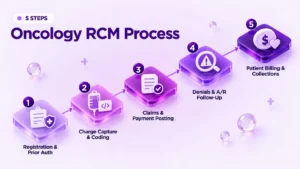
An effective oncology RCM workflow connects the front office, clinical staff, pharmacy, coding department, and billing team.
Each department provides information necessary for accurate reimbursement.
1. Patient Registration, Eligibility, and Prior Authorization
The revenue cycle begins when a patient schedules an appointment.
During registration, staff collect demographic information, insurance details, referral documentation, and information about secondary coverage.
Eligibility should be verified before scheduled treatment and whenever insurance coverage changes.
For high-cost services, authorization specialists should verify the medication or procedure, authorization period, approved units or visits, and any applicable site-of-care restrictions.
Practices should maintain an authorization tracking system that allows clinical and billing personnel to identify approvals requiring review.
2. Drug Charge Capture and Oncology Medical Coding
Once treatment is completed, the clinical record becomes the foundation of the claim.
For infusion services, documentation should include the medication administered, dosage, route, infusion start and stop times, and any discarded drug quantity.
Common administration codes include:
- CPT 96413: Initial intravenous chemotherapy administration infusion, up to one hour.
- CPT 96415: Each additional hour of qualifying chemotherapy administration infusion.
- CPT 96365: Initial intravenous infusion for therapy, prophylaxis, or diagnosis, rather than chemotherapy administration.
These codes are not interchangeable. Their selection depends on the documented service, drug classification, coding hierarchy, and applicable requirements.
The billing team must also calculate administered drug quantities according to the units specified by the relevant HCPCS code.
For example, if a medication’s billing descriptor specifies 10 units for each dose and a patient receives 180 units, the recorded administered quantity is 180 units.
The calculation may appear straightforward, but errors can occur when administration records, pharmacy records, and billing software use different units of measurement.
In radiation oncology, a similar reconciliation should connect treatment records with planning, delivery, and management charges.
3. Claims Submission and Payment Posting
Before submission, oncology claims should be reviewed for coding accuracy, eligibility, authorization information, required modifiers, and payer-specific billing rules.
A claim-scrubbing process can identify missing or inconsistent information before the claim reaches the payer.
After adjudication, payment posting should reconcile insurance payments, contractual adjustments, patient responsibility, and remaining balances.
Posting a payment does not necessarily mean the claim was paid correctly.
For high-cost medications, the billing department should compare actual reimbursement against the applicable payer contract or Medicare payment methodology.
This process helps identify underpayments that might otherwise go unnoticed.
4. Denial Management, Appeals, and A/R Follow-Up
Not every oncology denial can be prevented. However, repeated denials for the same reason often indicate an underlying workflow problem.
Effective denial management begins by identifying why a claim was not paid.
Was the authorization missing? Did the payer question medical necessity? Was the drug quantity inconsistent with the documentation?
The next step is determining whether the claim requires a correction, reconsideration, formal appeal, or additional medical records.
Accounts receivable (A/R) follow-up should prioritize claims based on age, financial value, filing deadlines, and recoverability.
A high-value drug claim approaching an appeal deadline may require immediate attention, even when several older, lower-value claims remain unresolved.
Revenue cycle leaders should regularly review denial patterns and ensure corrective actions are assigned to the department responsible for the original error.
5. Patient Financial Navigation and Collections
Cancer patients may receive bills from multiple providers while undergoing treatment.
Clear financial communication can reduce confusion and make payment arrangements easier to manage.
The Association of Cancer Care Centers’ (ACCC) Financial Advocacy Playbook describes financial advocacy activities such as benefits verification, insurance education, prior authorization support, financial distress screening, and assistance with available resources.
These activities can be incorporated into registration and financial counseling workflows at oncology practices.
Patients should receive clear explanations of their financial responsibilities, understandable cost estimates, and information about available assistance programs.
Financial navigation helps patients manage treatment-related expenses while reducing the likelihood that unpaid balances become difficult to collect.
Common Oncology Billing Challenges and Denial Causes
Many oncology billing problems can be traced to a small group of recurring operational issues.
| Billing challenge | Potential financial impact |
| Missing or outdated prior authorization | Claim denials or delayed treatment reimbursement |
| Incorrect J-code or drug units | Underbilling, overbilling, or claim rejections |
| Incomplete infusion documentation | Unsupported administration charges |
| Missing JW/JZ modifier when required | Drug claim processing errors |
| Insufficient medical necessity documentation | Coverage denials and appeals |
| Incorrect clinical trial billing responsibility | Improper payer or sponsor charges |
| Unresolved payer underpayments | Lost collectible revenue |
| Delayed A/R follow-up | Aging balances and missed appeal deadlines |
The most effective approach is to examine why these problems occur rather than treating every denial as an isolated billing mistake.
For example, if authorization-related denials increase, the practice should investigate communication between prescribing clinicians and authorization specialists instead of simply asking billers to submit appeals faster.
Best Practices to Improve Oncology RCM Performance
Improving collections does not always require a new EHR system or additional billing staff.
Often, measurable improvements begin with better coordination between existing departments.
Connect authorization records to treatment plans. Establish a process for notifying authorization staff whenever a physician changes a medication, dosage, or treatment schedule.
Reconcile drug inventory with billing records. Compare pharmacy dispensing information and administration documentation against captured charges to identify missing or inconsistent drug claims.
Maintain payer-specific billing rules. Commercial insurers and government programs may have different authorization, documentation, and reimbursement requirements.
Review denials by root cause. Track the reason for each denial, the responsible department, dollar value, and appeal outcome rather than relying only on total denial counts.
Audit high-value claims. Regular reviews of drug billing, infusion times, modifiers, and reimbursement can identify errors before they become recurring financial losses.
Use automation selectively. Eligibility checks, claim edits, and payment variance reports are useful automation opportunities. Complex medical necessity appeals and unusual treatment circumstances still require knowledgeable staff.
The strongest results generally come from combining accurate systems with clear accountability between departments.
Key Oncology Revenue Cycle Management KPIs
A monthly collections total alone is not enough for practice administrators to determine whether the revenue cycle is performing well.
Several key performance indicators (KPIs) provide a clearer picture of billing accuracy, payment delays, and collection performance.
| KPI | How to measure it | What it reveals |
| Clean claim rate | Claims accepted as a percentage of submitted claims ÷ 100 | Initial submission accuracy |
| Denial rate | Denied claims ÷ adjudicated claims × 100 | Frequency of payment obstacles |
| Days in A/R | Average number of days accounts remain outstanding | How long revenue remains uncollected |
| Net collection rate | Payments ÷ (charges minus contractual adjustments) × 100 | Collection performance for collectible revenue |
| A/R over 90 days | A/R older than 90 days ÷ total A/R × 100 | Aging and collection risk |
Practices should define each metric consistently because reporting methods may differ between billing systems.
For oncology organizations, overall KPIs should also be broken down by treatment category.
A practice may have an acceptable overall denial rate while experiencing significant reimbursement problems with specialty medications.
Separate reporting for drug claims, infusion administration, radiation services, and major payer contracts can make these problems easier to identify.
Rather than relying solely on industry benchmarks, practices should compare current performance with historical results and investigate meaningful changes.
Oncology Reimbursement and Compliance Considerations
Certain reimbursement rules deserve special attention because they directly affect oncology drug billing and revenue integrity.
JW/JZ Modifiers, Drug Wastage, and 340B
When medications are supplied in single-dose containers, some of the drug may remain unused after administration.
The JW modifier reports qualifying discarded drug amounts, while the JZ modifier indicates that no qualifying amount was discarded.
The CMS discarded drugs guidance explains how these modifiers apply to separately payable drugs supplied in single-dose containers or single-use packages.
This distinction matters because discarded quantities must be accurately documented and billed only when permitted.
Separate rules apply to eligible healthcare organizations participating in the 340B Drug Pricing Program.
Applicable Medicare billing requirements for drugs acquired through 340B include using the appropriate JG or TB modifier.
Additional information is available in the CMS Medicare Part B 340B modifier guidance.
Not every cancer center qualifies for 340B. Eligibility, purchasing, inventory management, and billing requirements depend on the organization’s circumstances.
Clinical Trial Billing and the Enhancing Oncology Model
Clinical trial billing requires a clear distinction between routine patient care and research-specific activities.
Under Medicare National Coverage Determination (NCD) 310.1, Medicare covers certain routine costs associated with qualifying clinical trials, subject to applicable requirements.
However, investigational items and sponsor-funded services are not automatically covered as ordinary insurance claims.
A coverage analysis should identify which charges belong to Medicare or another insurer and which are the sponsor’s responsibility.
Oncology organizations should also be aware of the CMS Enhancing Oncology Model (EOM).
This voluntary, episode-based payment model focuses on coordinated, patient-centered oncology care and holds participating practices accountable for quality and total spending during defined episodes.
For participating practices, the model creates additional reporting and financial management responsibilities beyond routine fee-for-service billing.
In-House vs. Outsourced Oncology Revenue Cycle Management
Both in-house and outsourced oncology RCM can work effectively. The better option depends on patient volume, treatment complexity, staffing capabilities, and financial performance.
An internal billing department provides direct oversight and may communicate more easily with physicians, pharmacy staff, and scheduling teams.
However, maintaining experienced oncology coders, authorization specialists, denial analysts, and billing personnel can be expensive.
Outsourcing may provide additional expertise and capacity, particularly for practices facing staffing shortages or substantial A/R backlogs.
The trade-off is that an external billing partner needs reliable access to clinical documentation and clear communication channels with the practice.
A hybrid arrangement is another option. A practice may retain patient financial counseling and treatment authorization internally while outsourcing claim processing, denial management, and A/R follow-up.
Before changing models, administrators should calculate total operating costs and compare actual collections performance rather than focusing exclusively on vendor fees or employee salaries.
How to Choose an Oncology RCM Partner
Not all oncology billing companies offer the same level of expertise, and choosing the right partner involves more than comparing advertised collection rates.
A company may perform well with routine office claims but lack experience in chemotherapy drug billing or radiation oncology reimbursement.
Before selecting a partner, ask how the company handles:
- Chemotherapy administration coding, J-code units, and drug wastage.
- Prior authorization changes during active treatment.
- Medical necessity denials and payer appeals.
- Identification of underpayments against contracted rates.
- Clinical trial billing and radiation oncology billing, where applicable.
- EHR integration, reporting transparency, and HIPAA-related safeguards.
Request sample reports showing denial trends, days in A/R, collections, and unresolved high-value claims.
Also clarify which services are included in the agreement. Some companies handle claims and collections but leave prior authorization, credentialing, or patient financial counseling to the practice.
A clear division of responsibilities can prevent costly gaps during onboarding and ongoing operations.
Frequently Asked Questions About Oncology RCM
What Are the Main Steps in the Oncology RCM Process?
The main steps include patient registration, eligibility verification, prior authorization, charge capture, medical coding, claim submission, payment posting, denial management, A/R follow-up, and patient collections.
Oncology practices must also coordinate medication purchasing and reimbursement throughout the treatment process.
Why Is Oncology Billing More Complicated Than General Medical Billing?
Oncology involves high-cost medications, changing treatment regimens, multiple administration codes, strict medical necessity requirements, and prolonged treatment courses.
Even small billing errors can significantly affect high-value claims.
What Causes the Most Common Oncology Claim Denials?
Common causes include authorization problems, coding inconsistencies, missing documentation, incorrect drug units, medical necessity issues, and payer-specific coverage restrictions.
Actual denial patterns vary by practice and payer.
How Can Oncology Practices Reduce Accounts Receivable?
Practices can improve eligibility verification, maintain accurate authorizations, submit complete claims promptly, follow up on high-value denials, identify payer underpayments, and establish consistent follow-up procedures for outstanding balances.
Should an Oncology Practice Outsource Revenue Cycle Management?
Outsourcing may be appropriate when a practice lacks specialty billing expertise, struggles with staffing, or experiences persistent denials and aging A/R.
Practices with strong internal teams may prefer to retain billing operations or outsource selected functions.
What Is the Difference Between Oncology RCM and Oncology Medical Billing?
Medical billing primarily focuses on claims, coding, and payments.
Oncology RCM covers the broader financial workflow, including insurance verification, authorizations, drug reimbursement tracking, financial counseling, collections, and reporting.
Building a More Reliable Oncology Revenue Cycle
A strong oncology revenue cycle begins long before a claim is submitted to an insurance company.
Accurate eligibility verification, coordinated authorizations, comprehensive clinical documentation, and consistent payment follow-up can help practices protect revenue while supporting uninterrupted patient care.
For organizations looking to improve these processes, VerifiMed offers medical billing and revenue cycle management support focused on reducing administrative workload and improving financial operations.
Reviewing existing denials, high-value claims, and aging receivables is a practical starting point for identifying where improvements are needed.