Dental Credentialing Services Florida: A Complete Guide for Dentists
Dental credentialing is the process insurance companies use to verify a dentist’s professional qualifications before approving participation in their networks. For dental practices in Florida, it connects a dentist’s professional credentials with insurance enrollment, contracting, and in-network patient care.
Whether you’re opening a dental office in Miami, hiring an associate in Orlando, or expanding your practice across several Florida locations, credentialing deserves attention well before the provider’s intended start date.
Dental credentialing services in Florida help practices organize documents, complete insurance applications, maintain CAQH profiles, and follow up with payers until participation decisions are confirmed.
Key Takeaways
- Florida dental licensure and insurance credentialing are separate processes.
- Each insurance network establishes its own participation requirements.
- A completed CAQH profile does not automatically make a dentist in-network.
- Florida Medicaid enrollment and dental-plan participation require separate attention.
- Credentialing continues after approval through profile updates and re-credentialing.
What Are Dental Credentialing Services in Florida?
Dental credentialing services help dentists establish and maintain their professional credentials with insurance companies and dental networks.
The work typically involves collecting provider information, verifying supporting documents, preparing payer applications, responding to requests for corrections, and tracking each application’s status.
A credentialing specialist may also assist with provider enrollment, contracting paperwork, and ongoing credential updates. This can be particularly helpful for practices managing several dentists or participating in multiple insurance networks.
For example, imagine a Florida dental practice hiring a new general dentist. The dentist already holds an active Florida license, but the practice wants the provider to participate in several commercial PPO networks.
The credentialing team needs to determine which carriers require new applications, whether the dentist already participates in any of those networks, and what information must be updated for the new practice.
How Is Credentialing Different From Licensing, Enrollment, and Contracting?
Licensing, credentialing, enrollment, and contracting serve different purposes, even though these administrative processes often overlap.
Process | What it means |
Licensing | State authorization to practice dentistry |
Credentialing | Verification of professional qualifications |
Payer enrollment | Registration with an insurance program or payer |
Contracting | Agreement establishing network participation terms |
Re-credentialing | Periodic reassessment of a participating provider |
A dentist can hold an active state license without participating in an insurance network. Likewise, submitting credentialing information does not automatically establish an active payer contract.
Before billing as an in-network provider, dental practices should confirm the applicable contract, participating provider identifiers, approved locations, and effective date.
What Are Florida’s Dental Licensing Requirements?
Dentists must have appropriate authorization to practice dentistry in Florida. Insurance credentialing commonly includes verification of the dentist’s professional license.
The Florida Board of Dentistry, operating within the Florida Department of Health’s regulatory system, oversees dental licensure.
Its published licensing information covers educational qualifications, examinations, professional background information, and available licensing pathways. These include licensure by examination and the MOBILE endorsement pathway for eligible applicants.
Dentists should review the requirements for their particular licensing pathway before applying. Initial licensure also involves applicable background-screening requirements.
The Florida Department of Health’s Division of Medical Quality Assurance (MQA) maintains licensing records and provides professional license verification.
Practices should confirm:
- The dentist’s name matches the license record.
- The license is active and appropriate for the intended practice.
- Any public restrictions or disciplinary information have been reviewed.
- License renewal responsibilities are being monitored.
Florida dental licenses generally follow a biennial renewal cycle. However, license renewal and insurance re-credentialing are separate responsibilities.
Practical advice: Start collecting insurance documents while licensure is being finalized, but confirm each payer’s rules for applications involving pending licenses.
What Documents Are Required for Dental Insurance Credentialing?
Dental insurance credentialing generally requires professional identification, education records, licensing information, insurance documentation, and accurate practice details.
Each carrier may have additional requirements or use its own application forms. Preparing a complete document file before applying can help reduce unnecessary follow-up.
Document or information | Why it matters |
Florida dental license | Confirms professional licensure |
Individual NPI | Identifies the rendering dentist |
Organization NPI, if applicable | Identifies the practice entity |
DEA registration, if applicable | Supports verification of controlled-substance prescribing credentials |
Malpractice insurance | Documents professional liability coverage |
Dental education records | Supports qualification verification |
Residency or specialty training | Documents relevant additional training |
Work history | Helps establish professional background |
CAQH profile | Provides reusable credentialing information |
W-9 and tax information | Supports contracting and payment setup |
Practice addresses | Identifies participating service locations |
The Centers for Medicare & Medicaid Services maintains the National Plan and Provider Enumeration System (NPPES), which issues National Provider Identifiers.
An NPI identifies a healthcare provider, but having one does not establish insurance participation.
For dental group practices, staff should distinguish the dentist’s individual NPI from any applicable organization NPI. Keeping these identifiers consistent across applications helps avoid confusion during enrollment.
Why Does the CAQH Profile Matter?
CAQH provides a centralized system through which participating organizations can access provider credentialing information with the provider’s authorization.
Many dentists recognize the system as CAQH ProView. Current materials also use the DataSpring and CAQH Provider Data Portal names.
According to the CAQH Provider Data Portal User Guide, providers are responsible for reviewing and attesting to their submitted information. They must also authorize appropriate organizations to access their profiles.
Completing a CAQH profile does not automatically submit an application to every dental insurance network a dentist wants to join.
Before considering the CAQH portion complete, confirm that each intended insurer can access the required information.
How Does Dental Insurance Credentialing Work With Florida Payers?
Florida dentists generally pursue insurance participation through the individual carriers or dental networks they want to join.
Potential commercial networks include Delta Dental, MetLife, Cigna Healthcare, Aetna, Guardian, Humana, United Concordia, and other dental insurers.
However, joining one company’s network does not necessarily mean the dentist participates in every dental insurance product that company offers.
Each network may have its own application, verification, contracting, and participation requirements.
What Should Dentists Check Before Joining a Network?
Before submitting an application, dentists should ask each payer about its current participation requirements and contract terms.
Important questions include:
- Is the relevant dental network accepting new providers?
- Does the payer require CAQH access or a separate application?
- Is participation approved individually, by practice, or both?
- Which office locations and specialties will be included?
- What contract and fee schedule will apply?
- How will the effective date be communicated?
A dental practice should also examine whether the agreement involves a leased network, PPO arrangement, or another participation structure.
Credentialing establishes eligibility for the network’s consideration. It does not replace reviewing reimbursement terms or confirming that the payer has finalized participation.
How Does Florida Medicaid Dental Credentialing Work?
Florida Medicaid dental participation involves both state Medicaid provider enrollment and the applicable dental-plan network arrangements.
The Florida Agency for Health Care Administration (AHCA) administers the state’s Medicaid program and publishes provider enrollment requirements.
Dentists considering Medicaid participation should understand the distinction between registering with the state program and becoming a participating provider with a particular dental plan.
Which Dental Plans Participate in Florida Medicaid?
AHCA’s published 2025–2030 Statewide Medicaid Managed Care dental-plan chart identifies DentaQuest and LIBERTY as awarded dental plans across the listed regions.
This distinction matters because older Florida Medicaid materials refer to a previous dental-plan arrangement that also included MCNA Dental.
Dentists should review AHCA’s 2025–2030 dental-plan information rather than assuming that an older list of participating plans remains current.
The official chart is an appropriate starting point for identifying the applicable dental plans. Individual network participation should still be confirmed with the relevant plan.
What Does Florida Medicaid Require From Dentists?
The Florida Medicaid Provider Enrollment Policy, February 2026, identifies enrollment options for dentists, including fully enrolled and limited enrollment categories.
The policy also describes application structures for sole proprietors, group members, and groups.
For dentists, the published documentation includes a professional license, the applicable Medicaid provider agreement, and DEA registration when required to prescribe controlled substances, along with generally applicable enrollment documents.
A dental practice considering Medicaid should:
- Determine the appropriate state enrollment category.
- Confirm individual and group application requirements.
- Complete the applicable state enrollment process.
- Contact the relevant dental plan about network participation.
- Verify that the dentist and practice locations are recognized by the dental plan.
- Obtain written confirmation before relying on an in-network effective date.
State Medicaid enrollment alone should not be treated as proof of an active dental-plan contract.
What Is the Step-by-Step Dental Credentialing Process in Florida?
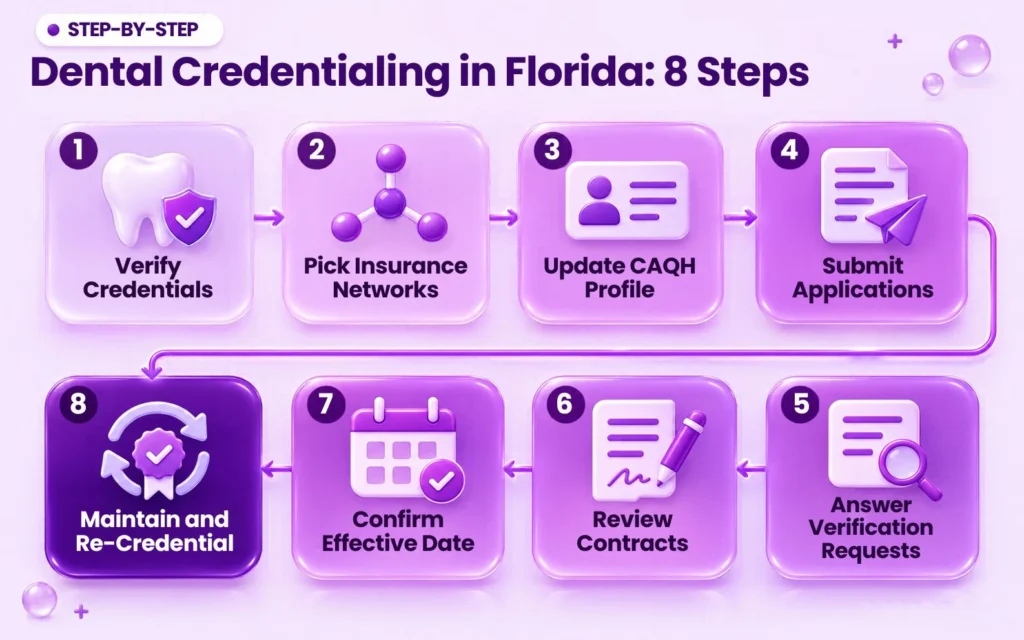
The dental credentialing process begins with confirming professional qualifications, then preparing provider profiles and submitting the required insurance applications.
A clear workflow helps dental practices track each step and recognize issues before they delay participation.
Step 1: Verify the Dentist’s Professional Credentials
Start by reviewing the Florida dental license, individual NPI, qualifications, malpractice coverage, and any applicable DEA registration.
Check that names, identifiers, and professional details are consistent. Resolve discrepancies before submitting applications.
Step 2: Identify the Target Insurance Networks
Choose the commercial or Medicaid dental networks the practice wants to pursue.
Confirm that each payer accepts applications for the relevant specialty and location. If the dentist already participates in a network, determine whether a new application or practice-affiliation update is required.
Step 3: Prepare or Update the CAQH Profile
Enter professional history, practice information, identifiers, and required documentation into the CAQH profile.
Review the information carefully, complete attestation, and authorize participating organizations to access the profile.
Step 4: Complete Payer Applications
Prepare and submit the applications and supporting documents required by each carrier.
Keep copies of submissions, confirmation numbers, reference numbers, and correspondence. These records help the office follow up without having to reconstruct the application history.
Step 5: Respond to Verification Requests
Payers may request missing documents, explanations of employment gaps, updated insurance coverage information, or corrections to practice details.
Assign someone to monitor these requests and respond promptly. An application can remain unresolved when the payer is waiting for additional information.
Step 6: Review Contracting Documents
If a payer offers participation, review the provider agreement, applicable network, fee schedule, and approved practice locations before accepting.
Credentialing approval and contracting should be tracked separately so the practice knows what remains outstanding.
Step 7: Confirm Approval and Effective Dates
Obtain written confirmation of network participation and the effective date.
Update the practice management system and internal insurance records before identifying the dentist as in-network.
An application receipt or verbal update should not be treated as final approval.
Step 8: Establish Ongoing Maintenance
Set up a process for CAQH attestations, license checks, re-credentialing activities, and provider or location changes.
Maintaining accurate information after approval is part of keeping insurance participation records current.
How Long Does Dental Credentialing Take in Florida?
Dental credentialing timelines vary by insurance carrier, application completeness, verification requirements, contracting arrangements, and network availability.
There is no single processing period that applies to every Florida dental insurance network.
A payer may finish reviewing a dentist’s credentials while contracting or practice-location enrollment is still underway. That difference matters when planning a provider’s in-network start date.
Common causes of delay include:
- Incomplete or outdated CAQH information.
- Differences between license and NPI records.
- Missing malpractice coverage information.
- Inaccurate tax identification or address details.
- Unanswered payer requests.
- Pending contracting documents.
Practices should request a current timeline directly from each payer and avoid scheduling an in-network start date based on an unconfirmed estimate.
Maintaining a record of submissions and pending requirements also makes it easier to identify where an application stands.
How Often Do Florida Dentists Need Re-Credentialing?
Re-credentialing is the periodic review insurance companies conduct to confirm that participating dentists continue meeting their requirements.
Each insurance network establishes its own re-credentialing schedule and documentation expectations. There is no universal two-year re-credentialing rule that applies to every Florida dental insurer.
Separately, current CAQH Provider Data Portal guidance specifies re-attestation every 120 days for Florida providers using that portal.
Re-attestation helps keep shared professional information current. However, it does not replace a payer’s formal re-credentialing process.
Dental practices should maintain a calendar for:
- Florida license renewal.
- CAQH re-attestation.
- Malpractice insurance renewal.
- Applicable DEA registration maintenance.
- Payer re-credentialing notices.
- Provider, ownership, and location changes.
Changes should be reported through the appropriate payer and regulatory channels. Updating a CAQH profile does not necessarily update every insurance contract automatically.
Credentialing for New Practices, Associates, and DSOs
Credentialing responsibilities can differ depending on whether a dentist is opening a practice, joining an existing office, or working across several locations.
Understanding these differences helps practice administrators prepare the correct information for each situation.
New Dental Practice
A new dental practice may need to organize individual provider credentials, business identification, tax information, practice locations, and insurance agreements at the same time.
This can involve coordinating information for the practice entity and each dentist who will be treating patients.
Starting the process early helps management understand which insurance networks may be available when operations begin.
Hiring a New Associate Dentist
An associate dentist’s previous network participation does not guarantee participation under a new employer’s tax identification number or contract.
Even when the dentist has an established CAQH profile and previously participated with an insurer, the new practice should verify the provider’s status.
The office manager should contact each payer and request any required affiliation or enrollment changes.
Multi-Location Practices and DSOs
Dental service organizations and multi-location practices need reliable records connecting each dentist with the correct service locations, business entities, and payer networks.
For example, a dentist working at two Florida offices may require payer-specific location updates, even if both offices belong to the same organization.
A centralized credentialing tracker can help administrators identify which approvals apply to each dentist and location.
In-House vs. Outsourced Dental Credentialing Services
Florida dental practices can manage credentialing internally or hire a credentialing company to handle administrative coordination.
Neither approach changes the payer’s underlying approval requirements. The difference is who manages the paperwork, communication, follow-up, and ongoing records.
Consideration | In-house credentialing | Outsourced credentialing |
Daily management | Practice employees | External specialists |
Staff workload | Managed internally | Administrative tasks delegated |
Payer follow-up | Office staff | Credentialing partner |
Record management | Internal systems | Shared or vendor-managed system |
Costs | Employee time and overhead | Contracted service fees |
Oversight | Direct supervision | Requires vendor reporting |
The right arrangement depends on the practice’s staffing capacity, number of providers, insurance networks, and preferred level of administrative oversight.
What Does an Outsourced Credentialing Company Handle?
An outsourced credentialing company typically handles document collection, CAQH profile maintenance, payer application preparation, submission tracking, re-credentialing coordination, and communication with insurance carriers.
Some providers also assist with enrollment changes or contracting paperwork, depending on their service agreements.
Not every company offers the same scope of work.
Before signing an agreement, practices should confirm whether contracting support, Medicaid enrollment, and post-approval maintenance are included.
How Much Do Dental Credentialing Services Cost in Florida?
Outsourced dental credentialing costs depend on the number of dentists, target insurance networks, practice locations, and services requested.
Providers may charge per application, per dentist, or through an ongoing management arrangement.
There is no single verified statewide price for dental credentialing services.
When comparing quotes, practices should ask whether the fees include application corrections, payer follow-up, re-credentialing, additional locations, and work on applications already in progress.
A lower initial fee may not cover every administrative task the practice expects the credentialing company to perform.
How Should Dentists Choose a Credentialing Service?
Dentists should select a credentialing service based on its documented scope, familiarity with dental payer workflows, communication practices, and recordkeeping procedures.
The service should clearly explain what it will handle and what remains the responsibility of the dentist or practice.
Before signing an agreement, confirm:
- Which Florida dental payers the company will handle.
- Whether CAQH setup and maintenance are included.
- Whether Medicaid enrollment is within scope.
- How application status will be reported.
- Who reviews and approves payer contracts.
- How confidential documents are protected.
- What happens when an application is returned or rejected.
- Who owns and can access credentialing records after termination.
Request a written scope of services and clear pricing before transferring responsibility.
Good reporting is especially useful when several applications are underway. Practice administrators should be able to identify submitted applications, outstanding documents, payer responses, and confirmed participation dates.
Common Dental Credentialing Mistakes to Avoid
Several administrative mistakes can interfere with insurance participation. Many are preventable when practices keep accurate records and confirm payer requirements before taking the next step.
Assuming licensure means network approval: A valid Florida dental license does not establish participation in an insurance network.
Submitting inconsistent records: Different names, addresses, tax information, or identifiers can trigger verification questions and delay an application.
Forgetting CAQH re-attestation: An outdated attestation may prevent participating organizations from using current profile information.
Overlooking practice-location changes: Approval associated with one office may not automatically cover another location.
Treating a submitted application as approval: Receiving confirmation that an application was submitted does not mean the dentist has an active participation agreement or confirmed effective date.
Ignoring contract details: Credentialing approval and acceptable reimbursement terms are separate considerations. Practices should review participation agreements before accepting them.
A documented credentialing workflow makes these issues easier to identify before they affect enrollment.
How a Credentialing Partner Like VerifiMed Can Help
VerifiMed offers provider credentialing and enrollment services as part of its medical billing and revenue cycle management services.
For dental practices considering outside administrative support, a credentialing partner can help organize provider information, coordinate applications, track documentation, and follow up on enrollment activities within the agreed scope of services.
Final credentialing decisions, network acceptance, and effective dates remain subject to the applicable payers and regulatory requirements.
Frequently Asked Questions About Dental Credentialing in Florida
1. How Long Does It Take to Credential a Dentist in Florida?
The timeline depends on the insurance carrier, completeness of the application, verification requirements, and contracting process. No universal Florida dental credentialing timeline applies to every payer. Dentists should ask each network for its current processing expectations and wait for written confirmation of the participation effective date.
2. Is CAQH Required for Dental Insurance Credentialing?
CAQH is commonly used to share credentialing information with participating dental plans, but not every payer necessarily requires the same platform or process. Some insurers request separate applications or additional documentation. Dentists should verify each carrier’s instructions and authorize the intended organization to access their CAQH information when applicable.
3. Can a Dentist See Patients Before Insurance Credentialing Is Approved?
A dentist with the appropriate active license may provide services within the scope of that license, but in-network insurance billing depends on payer participation rules. The practice must confirm how services will be billed before approval, including any patient financial responsibilities. Never assume that later approval automatically covers earlier treatment dates.
4. How Much Does Dental Credentialing Cost in Florida?
The cost depends on whether the practice uses internal employees or an outside credentialing service. External providers may charge by application, dentist, location, or ongoing management arrangement. Dentists should request an itemized quote and confirm whether follow-up, CAQH management, contracting assistance, and re-credentialing are included before comparing prices.
5. Does a Dentist Need New Credentialing When Changing Practices?
A dentist changing practices should verify participation requirements with each insurer. Existing professional qualifications and CAQH information may remain usable, but affiliation with a new business, tax identification number, or location can require additional enrollment or contracting steps. Previous in-network participation should not be assumed to transfer automatically.
6. Does Florida Medicaid Require Separate Dental Provider Enrollment?
Florida Medicaid has its own provider enrollment requirements, and dental-plan participation is a related but distinct consideration. Dentists should review AHCA’s current enrollment policy, determine the appropriate application category, and contact the relevant dental plan regarding network participation. State enrollment alone does not establish approval under every Medicaid dental-plan arrangement.
7. How Often Must Dentists Update Their CAQH Profiles?
Current CAQH Provider Data Portal guidance requires Florida providers using that portal to re-attest every 120 days. Dentists should also update relevant information when professional or practice details change. Formal insurance re-credentialing follows payer-specific schedules and should be tracked separately from routine CAQH attestation.
8. Can a Dental Credentialing Company Guarantee Insurance Approval?
No credentialing company controls an insurance carrier’s final participation decision. A company can assist with accurate documentation, submissions, communication, and follow-up, but approval depends on the applicable network’s requirements and decisions. Practices should be cautious about promises of guaranteed acceptance, fixed effective dates, or automatic participation in multiple networks.
Final Words
Dental credentialing services in Florida help practices manage the administrative work involved in joining and maintaining dental insurance networks.
The most effective approach combines accurate professional records, informed payer selection, consistent application tracking, and written confirmation of network participation.
Before submitting applications, verify current requirements with the Florida Board of Dentistry, Florida Department of Health, Florida Medicaid, and each insurance carrier.
Contact VerifiMed to discuss your dental credentialing and provider enrollment needs.
References