

A clinically appropriate occupational therapy session can still result in an unpaid claim. The problem may be as small as a missing GO modifier, an extra timed unit, or a daily note that does not explain why skilled treatment was needed.
For practice owners and billing teams, these errors mean delayed reimbursement and more time spent on follow-up. Billing for occupational therapy requires both sound clinical documentation and an understanding of each payer’s rules.
This guide explains OT evaluation and treatment codes, timed-unit calculations, Medicare requirements for 2026, OTA billing, and practical ways to reduce claim denials.
How Billing for Occupational Therapy Works
The billing process starts before the first treatment visit. Insurance eligibility, provider enrollment, prior authorization, medical necessity, and the plan of care can all affect payment.
A typical outpatient OT claim follows six steps:
- Verify benefits. Check coverage, network status, deductibles, copayments, visit limits, and authorization requirements.
- Evaluate the patient. Document functional limitations and medical necessity, then select the appropriate evaluation code.
- Establish the plan of care. Record the diagnosis, measurable goals, treatment type, frequency, and duration.
- Document each visit. Identify skilled interventions, qualifying treatment minutes, and the patient’s response.
- Submit the claim. Report diagnosis and CPT codes, units, modifiers, and the correct place of service.
- Reconcile payment. Review remittance advice, post payments and adjustments, and address rejected or denied claims.
Consider a patient recovering from wrist surgery who needs help dressing and preparing meals. The therapist may provide therapeutic exercise and self-care training during one visit. Each service needs a distinct purpose, supporting documentation, and the correct number of units under that patient’s insurance rules.
A rejection generally occurs before payer adjudication, often because required claim information is missing. A denial occurs after the payer processes a claim and decides not to pay it. That distinction helps the billing team choose the right next step.
OT Evaluation Codes Explained
Four CPT codes cover occupational therapy evaluations and re-evaluations:
CPT code | Evaluation type | When it applies |
97165 | Low complexity | Limited performance deficits and straightforward clinical decision-making |
97166 | Moderate complexity | More extensive assessment needs and moderately complex decisions |
97167 | High complexity | Extensive performance deficits and complex clinical decision-making |
97168 | Re-evaluation | Medically necessary reassessment under an established, ongoing plan of care |
Evaluation complexity depends on the patient’s occupational profile and history, assessment of occupational performance, and clinical decision-making. It is not determined simply by the time spent in the appointment.
How to choose the right evaluation code
A patient with a straightforward hand injury and a limited set of functional problems may support 97165. A patient recovering from a stroke with motor, cognitive, and self-care limitations may require a higher-complexity evaluation, depending on the findings.
OT evaluation codes are untimed. Their typical time references do not turn them into billable 15-minute treatment units. The record must support the level of complexity selected.
When is an OT re-evaluation billable?
Code 97168 may be appropriate when a meaningful change in the patient’s condition or response to treatment requires a formal reassessment and a review of the established plan of care.
For example, a patient develops new functional deficits following another medical event, and the therapist must reconsider treatment goals. Routine progress checks, repeated measurements, and scheduled progress reports do not automatically justify a separately billed re-evaluation.
Common OT Treatment CPT Codes
Most outpatient OT practices use a relatively focused group of treatment codes. Choose a code based on the skilled intervention provided, not simply the activity or equipment used.
The descriptions below are summarized from AOTA’s 2026 list of frequently used OT CPT and HCPCS codes.
CPT code | Service description | Billing type |
97530 | Therapeutic activities to improve functional performance | Timed, 15 minutes |
97535 | Self-care and home management training | Timed, 15 minutes |
97110 | Therapeutic exercise for strength, endurance, flexibility, and range of motion | Timed, 15 minutes |
97112 | Neuromuscular re-education for movement, coordination, balance, or posture | Timed, 15 minutes |
97140 | Manual therapy techniques | Timed, 15 minutes |
97150 | Group therapeutic procedures involving two or more patients | Untimed |
97129 | Cognitive-function interventions, initial 15 minutes | Timed |
+97130 | Each additional 15 minutes of cognitive-function intervention | Timed, add-on |
97533 | Sensory integration techniques | Timed, 15 minutes |
97542 | Wheelchair management, assessment, fitting, or training | Timed, 15 minutes |
97760 | Initial orthotic management and training | Timed, 15 minutes |
97763 | Subsequent orthotic or prosthetic management and training | Timed, 15 minutes |
97018 | Paraffin bath modality | Untimed |
Choosing between 97530 and 97535
These codes are easy to confuse. 97530 describes skilled therapeutic activities designed to improve functional performance, such as graded reaching or object manipulation. 97535 covers self-care and home management training, such as dressing strategies or safe use of adaptive equipment.
A graded reaching task intended to improve upper-extremity function may support 97530. Teaching a patient to use a dressing aid may support 97535. The note should explain the service performed and why it required skilled OT.
A valid CPT code does not guarantee payment. Coverage, provider qualifications, medical necessity, and payer-specific edits still apply.
Timed Codes and Medicare’s 8-Minute Rule
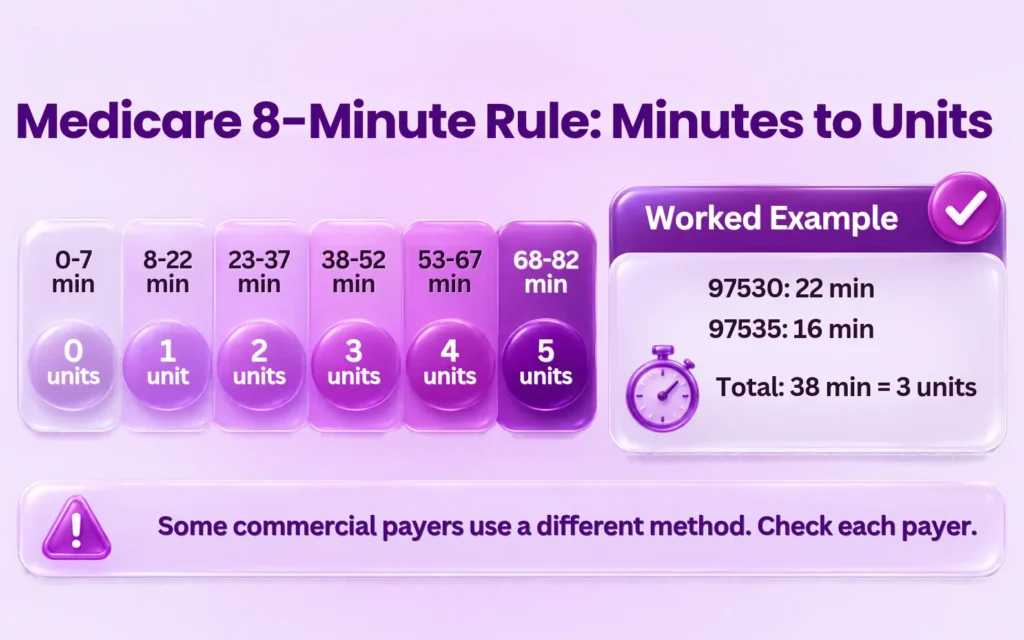
Medicare Part B combines qualifying minutes from 15-minute timed services to determine the total number of units for a treatment day.
Total qualifying timed minutes | Medicare billable units |
0–7 | 0 |
8–22 | 1 |
23–37 | 2 |
38–52 | 3 |
53–67 | 4 |
68–82 | 5 |
83–97 | 6 |
Minutes for untimed evaluations, group therapy, or supervised modalities cannot be added to increase the number of timed treatment units.
Worked Medicare billing example
Suppose an OT documents 22 minutes of therapeutic activities (97530) and 16 minutes of self-care training (97535). The total is 38 qualifying timed minutes, supporting three Medicare units.
CPT code | Minutes | Units |
97530 | 22 | 2 |
97535 | 16 | 1 |
Total | 38 | 3 |
Each service supports one complete 15-minute block. The additional unit is allocated to 97530 because it has more remaining minutes.
Medicare versus commercial timed-unit rules
Not every commercial payer follows Medicare’s total-time method. Some use the AMA/CPT midpoint method, also called the rule of 8s, which evaluates each code separately.
Using that method, the same 22 minutes of 97530 and 16 minutes of 97535 would generally support two units total, not three. Other insurers may establish different contractual requirements.
Maintain payer-specific billing instructions, and make sure therapists and billers use the same method. AOTA explains the distinction in its timed CPT codes guidance.
Modifiers Every OT Biller Must Know
Modifiers explain the discipline, circumstances, or provider involvement associated with a service. Missing or incorrectly applied modifiers can delay or reduce reimbursement.
GO: Occupational therapy plan of care
The GO modifier identifies applicable outpatient services performed under an occupational therapy plan of care. Medicare Part B generally requires it on OT therapy claim lines.
For example, self-care training may be reported as 97535-GO. GP identifies physical therapy, while GN identifies speech-language pathology. Do not substitute them for GO.
KX: Therapy beyond the annual threshold
The KX modifier indicates that services at or beyond Medicare’s applicable therapy threshold remain medically necessary and that supporting documentation is available.
KX is not an authorization and does not guarantee payment. The claim must still satisfy Medicare coverage and medical necessity requirements.
CO: Services furnished by an OTA
The CO modifier identifies outpatient OT services furnished in whole or in part by an occupational therapy assistant when Medicare’s OTA payment differential applies. Affected claim lines are generally paid at 85% of the otherwise applicable Medicare Physician Fee Schedule amount.
Under CMS’s de minimis policy, CO generally applies when the OTA independently furnishes more than 10% of a service or unit. Special exceptions apply, including certain final 15-minute units for which the OT personally provides at least eight qualifying minutes.
For example, a full unit of self-care training furnished independently by an OTA generally requires both GO and CO. When an OT and OTA divide care, document each person’s minutes and apply the current CMS allocation rules; the correct modifier cannot be determined from job titles alone.
59 and XU: Distinct procedural services
Modifier 59 identifies a distinct procedural service when coding rules allow an edit override and the documentation supports separate treatment. XU is a more specific modifier for an unusual, non-overlapping service.
Suppose therapeutic activities (97530) and manual therapy (97140) are provided during the same visit. The biller should check current NCCI code-pair edits and payer policies before deciding whether a modifier is needed or permitted. The note must show distinct services with no overlapping treatment minutes.
Do not add modifier 59 simply to make a denied claim payable. XE and XS may apply in other qualifying circumstances. Review the CMS NCCI Policy Manual and the applicable edit files.
Medicare Rules for Occupational Therapy in 2026
Medicare Part B covers qualifying outpatient OT when the services meet skilled-care, medical necessity, and documentation requirements. Two annual dollar thresholds are especially important.
The 2026 OT KX and medical review thresholds
2026 Medicare OT threshold | Amount | What it means |
KX modifier threshold | $2,480 | KX is required for medically necessary services at or beyond the applicable threshold |
Targeted medical review threshold | $3,000 | Claims may be selected for targeted review; review is not automatic |
These are separate OT thresholds. Physical therapy and speech-language pathology share their own combined thresholds.
Medicare no longer has a hard annual therapy cap. Medically necessary OT may continue beyond either amount when all coverage requirements are met. However, failure to report KX when required can cause a claim denial. See the CMS Therapy Services guidance.
Track annual expenses across providers
Threshold monitoring is based on cumulative Medicare therapy expenses, not a practice’s charges or the number of visits.
A patient may have received OT elsewhere earlier in the year. Those services can affect when KX becomes necessary. Check available Medicare information regularly and flag patients approaching the threshold instead of waiting for a denial.
Plan of care certification and recertification
A Medicare outpatient OT plan of care must identify the diagnosis, long-term goals, and type, amount, frequency, and duration of treatment. Certification generally involves approval by a physician or qualified nonphysician practitioner (NPP).
An initial certification exception has applied since January 1, 2025. Under specified conditions, a properly signed and dated physician/NPP order or referral may satisfy the initial plan-of-care signature requirement. Among other requirements, the therapist must document that the plan was delivered to the referring professional within 30 calendar days after the initial evaluation and that the signed plan was not returned within that period.
This exception does not remove the need for a plan of care or replace recertification requirements. Recertification is generally needed at the end of the certified plan’s duration, no later than 90 days, and when significant modifications require it.
Progress reports and medical necessity
Medicare requires a clinician progress report at least once every 10 treatment days. The report should describe functional status, response to treatment, measurable progress, and the continued need for skilled OT.
Slow progress alone does not make a patient ineligible for therapy. The record must still explain why the clinician’s skills are necessary. Full requirements appear in the Medicare Benefit Policy Manual, Chapter 15, Sections 220–230.
Medicaid, Pediatric OT, and Commercial Payers
Medicaid coverage varies by state, and managed Medicaid plans may impose additional provider-network and authorization rules. Commercial policies also differ in visit limits, medical necessity criteria, and treatment coverage.
For pediatric occupational therapy, pay particular attention to:
- Authorized dates, units, and visits
- Developmental diagnoses and medical necessity criteria
- Habilitative versus rehabilitative benefits
- Age restrictions and benefit limits
- Provider credentialing and plan-of-care updates
- Coordination of benefits when coverage overlaps
For example, a child’s sensory integration sessions may be clinically justified but denied if they occur after an authorization expires. Some plans also have specific restrictions on sensory integration or other specialized interventions.
Verify benefits before the evaluation and again when the plan, authorization, or insurance changes. Approval for an evaluation does not automatically authorize ongoing treatment.
OT Documentation That Supports the Claim
Documentation should connect the patient’s functional limitations with the skilled treatment delivered. Three records are particularly important.
Initial evaluation
Include the occupational profile, relevant history, assessment findings, performance deficits, clinical reasoning, and measurable goals. Explain how a deficit affects a meaningful activity.
“Reduced hand strength” describes an impairment. “Reduced grip strength prevents the patient from safely handling cooking utensils” explains its functional impact.
Daily treatment note
Record the treatment date, skilled interventions, qualifying minutes for each timed code, patient response, and appropriate clinician authentication.
For example: “Patient completed 16 minutes of graded dressing training using adaptive equipment. Required verbal cues for sequencing and safety; needed less assistance than at the previous visit.”
That note provides stronger support than “ADL training completed” because it identifies what occurred and how the patient responded.
Progress report
Compare current performance with baseline findings and established goals. Explain progress, remaining limitations, and why skilled services should continue. When treatment goals or frequency change significantly, update the plan and obtain the required approval.
Avoid copying identical general statements into every visit note. The record should reflect the patient’s actual presentation and the clinician’s decisions.
Top Reasons Occupational Therapy Claims Get Denied
Some denials are administrative. Others involve coverage rules or insufficient evidence of medical necessity. The most useful response depends on the reason reported by the payer.
Denial reason | What may have happened | Prevention or next step |
Missing GO | OT discipline not identified correctly | Check modifiers before submission |
Missing KX | Medicare OT threshold reached | Track cumulative therapy expenses |
Incorrect units | Minutes do not support billed units | Recalculate using payer-specific rules |
NCCI edit | A code pair fails a bundling edit | Review the edit and modifier rules |
Certification problem | Plan lacks required approval or exception evidence | Monitor certification deadlines |
Expired authorization | Visit falls outside approved dates or units | Track authorizations at scheduling |
Wrong place of service | POS does not match the treatment setting | Verify claim location details |
Medical necessity | Notes do not support continued skilled care | Document objective findings and clinical reasoning |
Incorrect CO | OTA involvement reported incorrectly | Track clinician-specific minutes |
Enrollment issue | Rendering provider is not properly enrolled | Check payer enrollment and effective dates |
Example: Treatment after authorization expires
A pediatric OT practice continues treatment after the authorized period ends. Even with good clinical notes, the insurer may deny the visits.
The billing team should review whether reconsideration or retroactive authorization is possible. Going forward, alerts should identify authorizations approaching expiration.
Example: Too many timed units
A therapist documents 30 qualifying timed minutes but reports three Medicare units. Under the 8-minute rule, 30 minutes support two units, not three.
Correct the claim as appropriate and check whether the same calculation error occurred on other dates.
Example: Documentation does not support skilled care
A patient’s notes repeat the same phrases across multiple visits without showing current limitations, clinical decisions, or a reason for continued treatment. The payer requests records and questions medical necessity.
A stronger note connects functional findings, skilled intervention, patient response, and the need for further care. For every denial, review the remittance reason and payer policy before submitting a corrected claim or appeal within the applicable deadline.
Should You Outsource Occupational Therapy Billing?
An in-house billing team can be a good choice for an OT practice with manageable claim volume, accurate documentation, and consistent payer follow-up.
Outsourcing may make sense when denials accumulate, accounts receivable grows, or clinicians and office managers spend too much time correcting claims.
Before selecting a partner, ask how it handles OT CPT codes, Medicare thresholds, OTA modifiers, payer-specific timed units, authorization tracking, and coding edits. Also ask how it reports denials and unpaid balances.
VerifiMed’s medical billing services include coding support, denial management, revenue cycle management, and provider credentialing. VerifiMed advertises a billing rate of 2.99% of monthly collections; confirm the services and pricing terms in the proposed agreement.
For an OT practice, the goal is not just faster claim submission. It is accurate billing, timely follow-up, and clear visibility into reimbursement.
Frequently Asked Questions About Occupational Therapy Billing
1. What CPT codes are most commonly used for occupational therapy?
Common codes include 97165–97168 for evaluations and re-evaluations, 97530 for therapeutic activities, 97535 for self-care training, and 97110 for therapeutic exercise. Other frequently used codes include 97112, 97140, 97150, and 97542.
2. How does the 8-minute rule work for occupational therapy?
For Medicare Part B, total qualifying timed minutes determine billable units. 8–22 minutes support one unit, 23–37 support two, and 38–52 support three. Some commercial insurers use different calculations.
3. Is the GO modifier required for occupational therapy?
Medicare Part B generally requires GO on applicable outpatient services under an OT plan of care. Verify the requirements of commercial and Medicaid plans separately.
4. Can occupational therapy assistants bill Medicare?
Eligible outpatient services furnished by an appropriately supervised OTA can be billed through the enrolled provider or supplier under applicable Medicare rules. When CO is required, the affected service is generally paid at 85% of the otherwise applicable rate.
5. What is the Medicare OT therapy threshold for 2026?
The 2026 Medicare KX modifier threshold is $2,480 for OT, separate from the combined PT/SLP threshold. The targeted medical review threshold is $3,000. Neither is a hard limit on medically necessary treatment.
6. Can 97530 and 97535 be billed on the same day?
Yes, when both services were separately provided, medically necessary, and documented, and payer rules permit billing them together. Do not count the same treatment minutes for both codes.
7. Does Medicare require a physician referral for outpatient OT?
A separate referral is not universally required, but Medicare requires a valid plan of care and appropriate certification. Since 2025, a qualifying signed order or referral can satisfy the initial certification signature requirement when all conditions of the exception are met.
8. Why are occupational therapy claims denied?
Common causes include missing modifiers, incorrect timed units, expired authorization, coding edits, enrollment problems, and weak medical necessity documentation. Review the exact payer denial reason before correcting or appealing a claim.
Conclusion
Accurate billing for occupational therapy depends on matching CPT codes to skilled interventions, calculating timed units under the right payer method, and documenting why care is needed. Medicare practices must also track annual therapy expenses, certifications, and OTA participation.
A reliable process catches errors before submission and follows every claim through payment. Practices that need help with coding, credentialing, or denial follow-up can explore VerifiMed as an outsourced billing option.